The digital signage software market is consolidating fast, and the real risk to your network is not that a vendor disappears overnight. It is that you have no plan for the day they get acquired, sunset a product, raise prices, or quietly stop supporting your use case. The fix is not panic. It is knowing your exit options before you need them: can you export your content and data, are you locked to proprietary hardware, who actually owns your access, and could you switch platforms without ripping out every player?
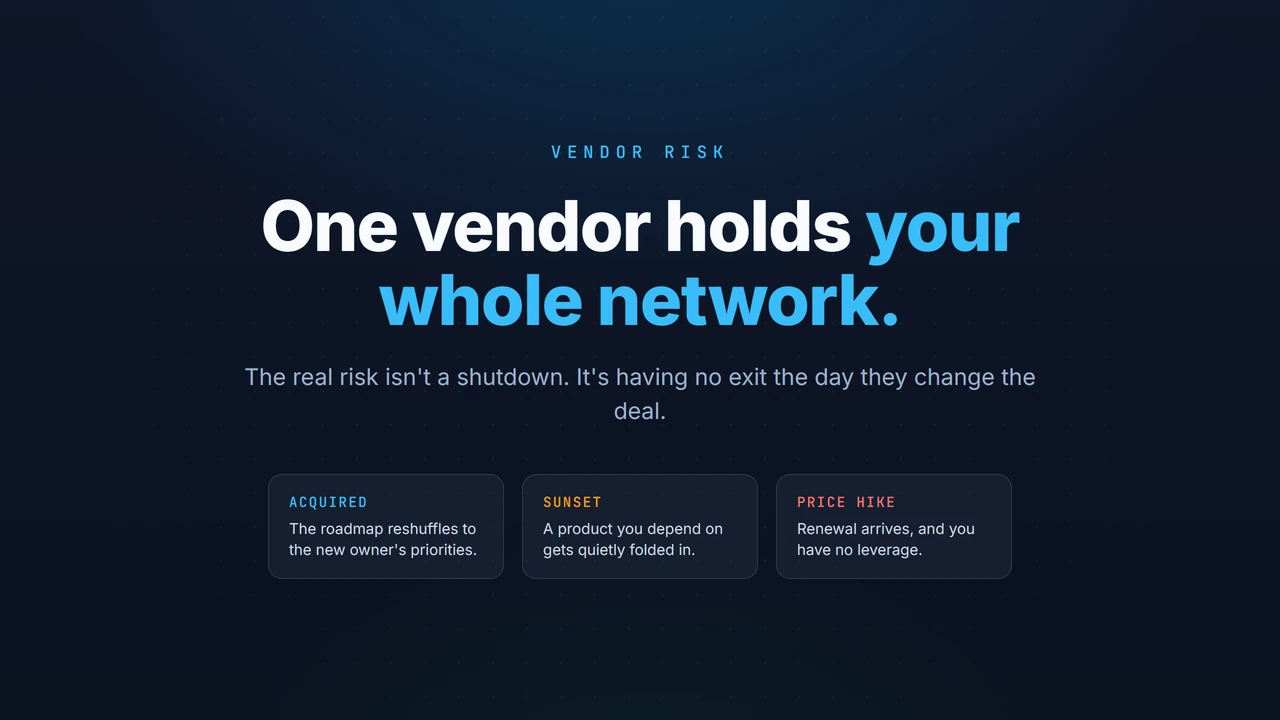
The Risk Isn't Bankruptcy. It's Dependency.
When a signage vendor makes the news for the wrong reasons, the first question everyone asks is "are they going under?" It is the wrong question. Whole companies rarely vanish overnight, and even when one division winds down, the screens usually keep playing for a while. The thing that actually hurts you is slower and quieter than a shutdown.
It looks like this. The vendor gets acquired, and the roadmap you were promised reshuffles to fit the new owner's priorities. Renewal comes around and the price has moved, or the contract terms have. The support team you knew is reorganized, and tickets that used to close in a day now take a week. A product line you depend on gets "merged into the platform," which is a polite way of saying it is going away. None of these is a fire. All of them are smoke.
This is not hypothetical. Through 2026, STRATACACHE, one of the biggest names in the industry, came apart in public: layoffs at its Dayton headquarters, subsidiaries in the US, Canada, and the UK handed to liquidators, its factory campus sold off, and in May it offloaded its flagship CMS, Scala, to Sweden's Vertiseit. Scala's screens did not go dark. It changed owners, and the new owner is focused on retail. If you run Scala in a hospital, a school, or a city building, nobody switched you off, but the roadmap and the priorities you bought into are now someone else's call. That is the risk. Not the lights going out, the deal changing under you. And STRATACACHE is just the loudest case. Platforms are being bought, merged, and folded into bigger players every few months.
And here is the uncomfortable part: most of that risk was baked in long before the news broke. It was baked in the day you let one company own your hardware, your player software, your content management system, and your data, with no realistic way to separate them. That is not a vendor problem. That is an architecture problem, and it is yours to fix.
What Actually Changes When a Vendor Changes
It helps to be specific about the failure modes, because "the vendor is in trouble" is too vague to plan against. In practice, here is what lands on your desk.
The roadmap pivots
Features you were counting on slip or get cut because they no longer fit the new owner's strategy. The integration you needed next quarter is now "under review."
The renewal gets expensive
Pricing and terms get revisited, often in the acquirer's favor. You find out how much leverage you actually have, which is usually less than you assumed.
Support gets thinner
Teams reorganize, familiar contacts leave, and response times stretch. The platform still works, but the humans behind it are harder to reach when it does not.
A product quietly sunsets
A tool you rely on gets folded into something else or end-of-lifed. You get a migration deadline you did not ask for, on a timeline you did not set.
Notice that none of these require the company to fail. They happen during ordinary consolidation, the kind the signage software industry is going through right now. So the goal is not to predict which vendor wobbles next. The goal is to make sure that when any of them does, it is an inconvenience for you and not a crisis.
The Four Questions That Reveal Your Real Risk
You can size up your exposure in an afternoon. Try to answer these four without calling your vendor. The ones you cannot answer are exactly where your risk lives.
1. Can you get your stuff out?
Content, playlists, schedules, screen groups, user lists, and proof-of-play data. In a usable format, not a screenshot. If the answer is "we would have to ask," you do not control your own network.
2. Are you married to the hardware?
Does your content only run on one vendor's players or displays? If switching software means physically replacing every device, that is not a CMS, it is a leash.
3. Who actually holds the keys?
Admin access, API access, documentation, account ownership, and backups. If all of that lives with the vendor or one employee who left, you are one bad week from locked out.
4. Could you switch without going dark?
Is there a realistic path to move platforms while the screens keep running? If you have never thought it through, you do not have an exit. You have a hope.
The pattern across all four is the same word: portability. A healthy stack is decoupled, hardware-agnostic, and built on open interfaces, so any single piece can be replaced without taking the whole thing down. A risky stack is the opposite, and the contract rarely tells you which one you have. The architecture does.
Can you see, from one screen, which displays are down, which players failed, and whether your content actually played? Remote device management used to be a premium add-on. It is now baseline plumbing. If you cannot answer "which screens are down right now?" without sending someone to look, that gap is its own kind of vendor risk, regardless of who the vendor is. A network audit will surface it fast.
Run this on your own network in about 15 minutes. Ten sections, a scoring guide, and the exact questions that reveal where you are locked in. Free PDF, no email required.
How to De-Risk Without Ripping Everything Out
The good news is that the fix is mostly planning, not a forklift. You do not need to migrate tomorrow. You need to make sure you could, calmly, if you had to. That is a continuity plan, and it is the cheapest insurance in this whole category.
Write the exit you hope you never use
Document how you would move: what data comes out, in what format, where it goes, what breaks, and how long it takes. The act of writing it exposes the gaps while they are still cheap to fix.
Secure your own access
Own the admin accounts, the API keys, the documentation, and recent exports of your content and data. Do not let your network's keys live only on the vendor's side of the table.
Favor decoupled choices going forward
When you next buy hardware, players, or software, prefer the option that does not trap the other two. API-first and hardware-agnostic is not a buzzword, it is what lets you replace one vendor without replacing all of them.
Keep your content portable
Standardize templates and file formats, keep source files you own, and avoid building everything in a proprietary editor you can never export from. Future-you will be grateful.
If you want a structured version of this, that is what a software and stack audit is for: a clear-eyed read on where you are locked in, what it would cost to leave, and what to fix first. You do not have to act on it. But you should know it.
When to Stay, and When to Actually Migrate
A loud news cycle is not a migration plan. Migration is genuinely disruptive and expensive, so it should be a decision you make on the numbers, not a reflex you make on a headline.
Stay when the platform still does the job, your data and hardware are portable, and your only real problem is nerves. In that case the right move is the continuity plan above, not a rebuild. You keep your leverage and your options without paying the cost of switching.
Migrate when the platform itself is the bottleneck: missing features you actually need, weak support, rising costs with no matching value, or an architecture that traps you. That is a real reason to move, and there is a right way to do it that does not wreck your network in the process. I wrote a full walkthrough of that here: how to switch digital signage platforms without wrecking your network.
The worst version is the one I see most: a team that is unhappy with their platform, too nervous to plan an exit, and too stuck to negotiate. They have no leverage because they have no alternative. Building the alternative, even just on paper, is what gives you a seat at the table.
That alternative is exactly what the Migration Readiness Assessment produces: an inventory, a breakage report and a scored shortlist you can take into a renewal negotiation, whether or not you ever move.
Why You Want This Read From Someone Neutral
Here is the catch with asking a vendor whether you are too dependent on a vendor. They are not the right person to grade their own lock-in. Neither is the reseller who earns a margin on the hardware, or the integrator who would rather not reopen a closed project.
I do not sell hardware, I do not take software commissions, and I do not have a platform I need you to land on. That means when I tell you your stack is fine, you can believe it, and when I tell you it is a problem, that is not a sales pitch either. The whole point of an independent read on vendor risk is that the person giving it has no vendor of their own to protect. For more on spotting that difference, see when you actually need an expert, and when you do not.
- The real vendor risk is dependency, not bankruptcy. Acquisitions, sunsets, and price hikes hurt you long before any shutdown would.
- Most of that risk is architecture, not bad luck: one vendor owning your hardware, player, CMS, and data with no way to separate them.
- Size your exposure with four questions: can you export your data, are you locked to the hardware, who holds the access, and could you switch without going dark.
- Remote device management is now baseline. If you cannot see which screens are down, that is its own risk.
- De-risking is mostly planning: write your exit, own your access, favor decoupled choices, keep content portable.
- Stay if the platform works and you are just nervous. Migrate when the platform itself is the bottleneck, and do it on a plan, not a headline.
Jordan Feil is an independent digital signage consultant with 17 years of industry experience. He has worked as a product manager at Navori Labs, a technical account manager, and a global marketing director before founding JAF Digital Consulting. He works with operators, vendors, and integrators on strategy, software selection, network audits, and go-to-market. No commissions, no vendor relationships that shape what he recommends.